
Dubai Real Estate Trends 2026: Prices, Growth & Investment Forecast
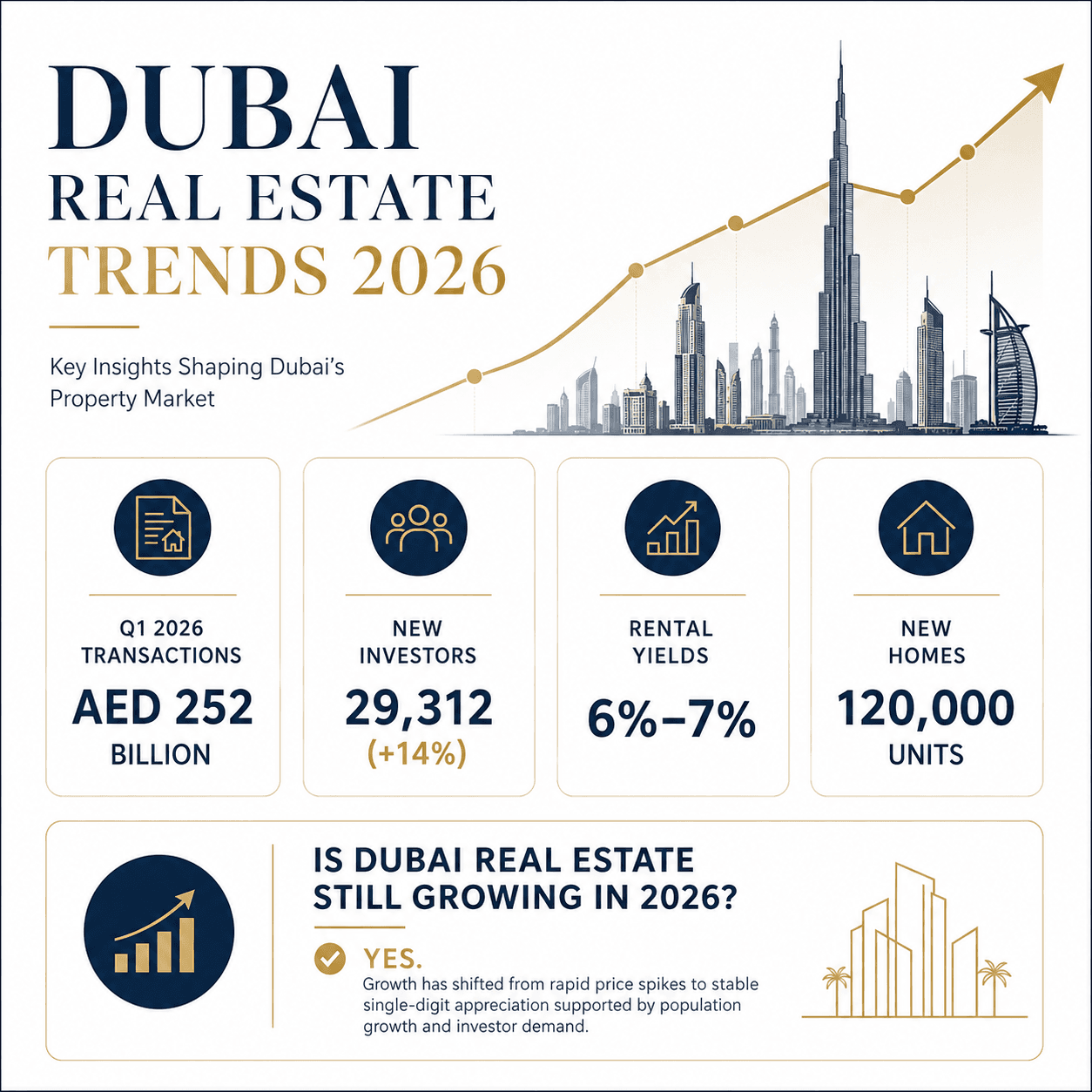
Dubai's real estate market in 2026 is shifting from rapid price spikes to steady, single-digit growth. The year opened with a record first quarter, AED 252 billion in transactions, up 31% year-on-year, while rental yields hold around 6 to 7% and roughly 120,000 new homes are due for handover to keep supply balanced. For investors, 2026 rewards patient, long-term positioning over quick flips.
Latest snapshot (mid-2026)
- Q1 2026 total transactions: AED 252 billion, up 31% year-on-year in value and 6% in volume. A record first quarter.
- May 2026 property deals: AED 28.51 billion across 10,218 transactions. Steady activity.
- New investors (Q1 2026): 29,312 first-time investors, up 14%. A widening buyer base.
- Average gross rental yield: around 6 to 7%, rising to 6.5 to 8.5% in high-demand apartment zones.
- New homes due in 2026: roughly 120,000 units. Supply is rising.
- Price trend: single-digit growth, stabilising after years of sharp gains.
For the full month-by-month breakdown, see our Dubai real estate market trends for May 2026.
Dubai real estate market 2026: from fast growth to steady balance
2025 was a landmark year. Property sales reached a record AED 682 billion, part of a total transaction value of AED 917 billion (+20% year-on-year) once mortgages and gifts are included, the strongest year in the Dubai Land Department's history. Momentum has carried straight into 2026: the first quarter alone recorded AED 252 billion in transactions, a 31% jump on Q1 2025 and the strongest opening quarter on record.
The character of that growth is changing, though. Sales activity stays high, but prices are settling into a more sustainable, single-digit range. The market is maturing rather than cooling.
This stability rests on real economic strength, not speculation. Non-oil sectors now make up roughly 75.5% of the UAE economy, with growth expected near 5% in 2026. Dubai's property growth is anchored to a diversified, working economy, and to government targets like the Dubai Real Estate Strategy 2033, which aims to lift annual transaction volume toward AED 1 trillion.
Global confidence remains high, with sustained inflows of high-net-worth individuals and institutional capital from the UK, India, the Americas and beyond. We unpack this in our analysis of why Dubai continues to attract long-term global real estate capital.
Will Dubai property prices drop in 2026?
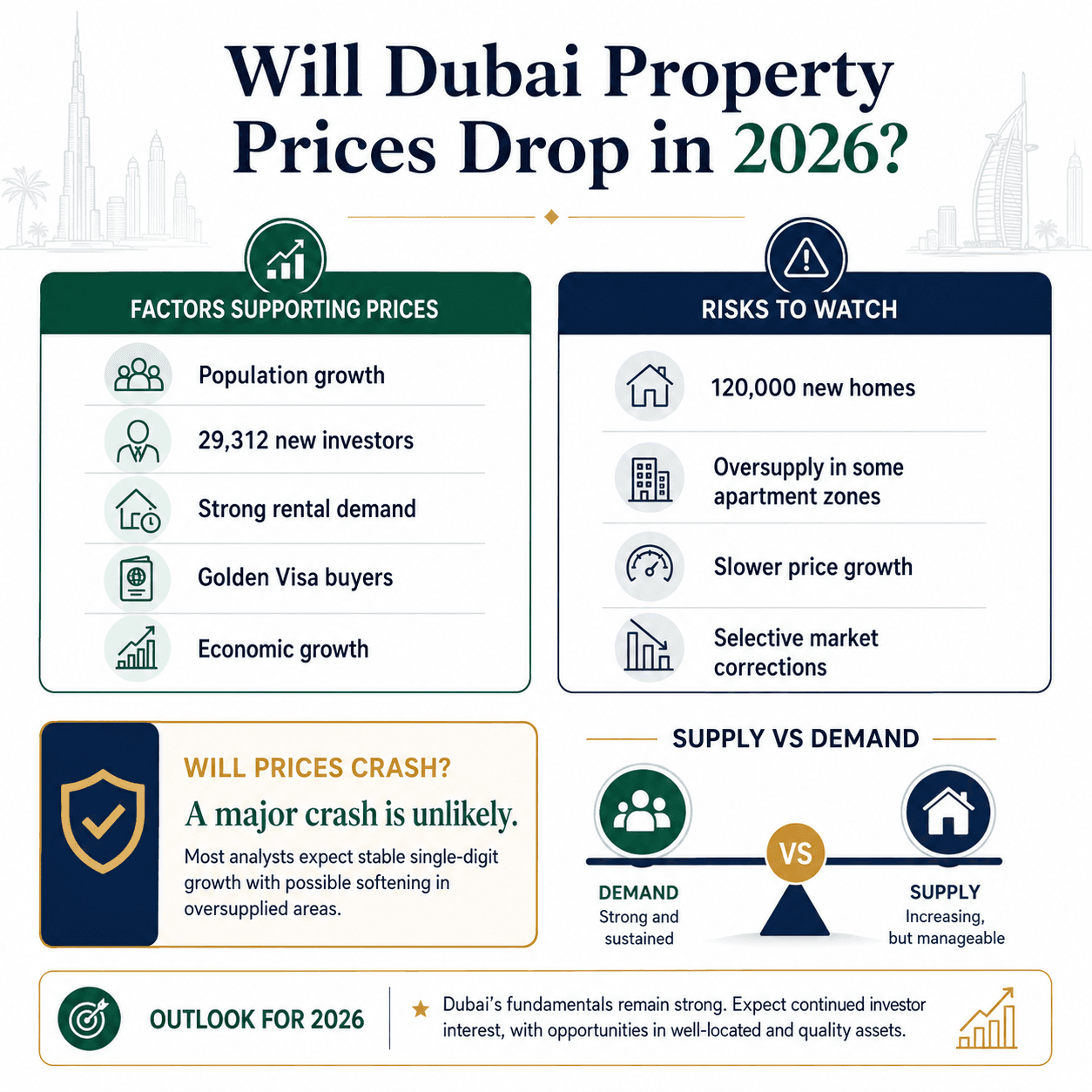
It's the most common buyer question, and the honest answer is that a sharp crash is unlikely, but the era of double-digit annual jumps is easing into single-digit growth.
A frequent worry is oversupply: with around 120,000 new homes due for handover in 2026, won't prices fall? The data suggests new supply is largely being absorbed. Dubai adds roughly 470 new residents every day, creating demand for about 150 new homes daily. As the population pushes beyond 4 million, that supply acts as a release valve that stops prices overheating rather than collapsing them.
It's worth staying balanced here. Some analysts, including Fitch, have flagged that the large delivery pipeline through 2025 to 2026 could trigger a moderate correction in certain segments, with bearish scenarios discussing softening of anywhere from a few percent to the mid teens in oversupplied, apartment-heavy areas. The takeaway isn't panic; it's selectivity. Well-located, well-built homes in supply-constrained communities are far more insulated than speculative off-plan stock in saturated zones.
Developers are also adapting with flexible and post-handover payment plans, including many boutique real estate developers in Dubai, while the DLD's 30% minimum-payment rule has cooled speculative flipping, both of which support a healthier, less volatile market.
Who is buying, and why it matters for prices
To see where prices are heading, look at who is moving in. Government policy has shifted the type of buyer entering the market. Programs like the Golden Visa and relaxed residency rules push buyers toward long-term ownership rather than short-term renting. In Q1 2026 alone, Dubai attracted 29,312 first-time investors (up 14% year-on-year), widening the base of committed, end-user demand. (Property investment is one route to qualify, see our guide to the UAE Golden Visa requirements and benefits.)
More owner-occupiers means more stability: fewer panicked sell-offs, smaller price swings, and firmer long-term values.
Dubai property prices 2026: what you'll actually pay
Pricing in 2026 varies sharply by area and product type:
- City-wide average: roughly AED 1,100 to 1,400 per sq ft across most communities.
- Premium zones: Palm Jumeirah, Downtown Dubai and Dubai Marina regularly exceed AED 2,000 per sq ft.
- Villas: average villa values are tracking around AED 6.16 million, with the strongest demand in Palm Jumeirah, Dubai Hills and Emirates Living.
- Value entry points: new launches in Dubai South and Dubailand remain the most affordable routes in for budget-conscious buyers.
Dubai property prices 2026: where to invest
Different goals point to different areas in 2026.
Luxury leaders (status + long-term value)
Downtown Dubai, Palm Jumeirah and Dubai Hills remain top-tier. Limited land for new projects keeps demand ahead of supply, supporting prices over time.
Emerging growth zones (higher upside)
- Dubai South & Expo City, growth driven by the Al Maktoum International Airport expansion and long-term city planning.
- Liwan & Al Furjan, more affordable entry prices with strong transport links, attractive to mid-range investors.
- Tilal Al Ghaf & Dubai Hills villas, among the strongest recent capital-growth performers, with double-digit annual appreciation reported in select communities.
If you're buying from abroad, understand the framework first, including how safe it is to buy property in Dubai.
Mixed-use communities (rent faster, hold tenants longer)
Demand is rising for places to live, work and relax in one location. Communities blending homes, offices, retail and leisure are renting faster and retaining tenants longer, a quieter but important 2026 trend.
Dubai rental market outlook 2026: what yields to expect
For income-focused investors, conditions stay strong. A steady flow of new residents keeps demand high, and average gross rental returns remain around 6 to 7%, rising to 6.5 to 8.5% in high-demand apartment communities like JVC and Business Bay, and comfortably ahead of major cities like London or New York.
Tenant preferences are shifting toward larger homes, villas and suburban communities with parks and schools, lifting rents in well-planned residential areas. You can model your own numbers with our Dubai rental yield calculator.
What's shaping the 2026 market: the new standard
Buyers in 2026 expect more than four walls:
- Green building, the UAE's Net Zero 2050 goal is making energy-efficient, sustainable homes the norm. These often command higher resale and rental values thanks to lower running costs.
- PropTech & fractional ownership, blockchain and property tokenisation let investors buy small shares rather than whole units, widening access and liquidity.
- Smart homes, keyless entry, smart climate control and modern security are now expected, not optional. Homes without them risk slower appreciation.
Dubai real estate market statistics 2026 (at a glance)
- Q1 2026 total transactions: AED 252 billion, up 31% year-on-year.
- Q1 2026 transaction count: 60,303 transactions.
- May 2026 deals: AED 28.51 billion across 10,218 transactions.
- 2025 total property sales: AED 682 billion, a record.
- 2025 all-in transaction value: AED 917 billion, up 20% year-on-year.
- New homes due in 2026: roughly 120,000 units.
- New residents per day: around 470.
- Average price per sq ft: AED 1,100 to 1,400, rising above AED 2,000 in prime zones.
- Average gross rental yield: around 6 to 7%, up to 6.5 to 8.5% in top apartment zones.
- Non-oil share of UAE economy: around 75.5%.
Is Dubai real estate a good investment in 2026?
The data points to yes, for the right strategy. The market is stable, growing and well-supported by population and economic fundamentals, with a record Q1 confirming demand is intact. Buyers have more choice and better payment options; sellers still benefit from strong demand and rental income. Against unstable global markets, Dubai stands out for safety, tax efficiency and long-term security. The one caveat: with supply rising, location and build quality matter more than ever. Patient capital in the right community wins; speculative bets in oversupplied areas carry more risk.
Frequently asked questions
Is Dubai real estate a good investment in 2026? Yes, particularly for long-term investors. Single-digit price growth, around 6 to 7% rental yields, no annual property tax and strong population-driven demand make 2026 a favourable entry point, provided you focus on well-located, quality stock rather than oversupplied speculative units.
Will Dubai property prices drop in 2026? A sharp crash is unlikely. Around 120,000 new homes are being absorbed by daily population growth of around 470 residents, keeping prices balanced. Some softening is possible in oversupplied apartment zones, so location selectivity matters.
What rental yield can I expect in Dubai in 2026? Average gross yields sit around 6 to 7%, rising to 6.5 to 8.5% in high-demand apartment communities such as JVC and Business Bay, higher than most major global cities. Use our rental yield calculator to estimate yours.
How did Dubai's market perform in early 2026? Q1 2026 set a record for any first quarter, with AED 252 billion in transactions (+31% year-on-year) and 29,312 new first-time investors. May 2026 added a further AED 28.51 billion across 10,218 deals.
Which areas are best to invest in for 2026? Downtown Dubai, Palm Jumeirah and Dubai Hills for luxury and stability; Dubai South, Expo City, Liwan, Al Furjan and Tilal Al Ghaf for higher growth potential.
Is it safe to buy property in Dubai as a foreign investor? Yes, within a clear regulatory framework. See our guide on how safe it is to buy property in Dubai.
Turn market insight into measurable value
Whether you're evaluating land, planning a boutique development, or seeking stable long-term returns, informed decisions matter more than ever. MSN Developments, a boutique real estate developer company, helps you identify the locations, formats and strategies aligned with Dubai's 2026 fundamentals.
Table of Contents